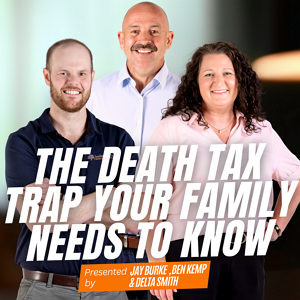
- From Fine Answers podcast – Jay Burke, Delta Smith and Ben Kemp
The taxes that reduce an estate are mostly invisible, because beneficiaries may only see the amount that lands in the account.
A parent dies. The paperwork is done, the estate is settled, and a sum arrives in the adult child’s bank account. Thanks, Mum and Dad.
What they will probably never see is the amount that went somewhere else on the way through. In the example the team works through on the podcast, a beneficiary receives around a quarter of a million dollars and has no idea that tens of thousands went to the ATO before it reached them.
That is the awkward thing about Australian estate taxes. Officially there is no death tax. In practice several taxes apply on the way through, and because beneficiaries are only ever shown the net figure, most never learn what was taken.
On this episode of the Fine Answers Podcast, Jay Burke, Delta Smith and Ben Kemp of Burke Britton Financial Partners work through where those costs actually come from — and why some of them are easier to deal with years in advance than in the weeks after a death.
By Jay Burke, Certified Financial Planner; Delta Smith, Financial Planner – SMSF Specialist; and Ben Kemp, Certified Financial Planner. Burke Britton Financial Partners.
KEY IDEA: There is no single death tax to avoid. There is a series of ordinary taxes that apply as assets move — and some of the options for dealing with them close once someone has died, or lost the capacity to make decisions.
Superannuation is can be where it bites
The most common version involves super paid to adult children. Delta said this outcome can be surprising for some families: super left to an adult child who is not a financial dependent can be taxed in a way it would not be if it went to a spouse.
The reason sits in how the money went in rather than who it goes to. Contributions that were taxed going in form a component that can be taxed again on the way out, depending on who receives it.
Delta’s framing is worth holding onto: superannuation, stripped back, is a tax structure. That is why proposed changes to investment taxes so often arrive in the media under a headline about death taxes.
The ones nobody counts
Super is only the visible part. Assets sold to settle an estate can trigger capital gains tax. The estate itself is an entity that lodges a return and pays tax while it exists, which beneficiaries and executors frequently do not realise.
Then there is stamp duty. Where a property is left to two siblings and one takes it on, duty can apply to the share being transferred — even where that was always the family’s intention. It is an avoidable cost more often than not, but only if someone looks at it before the transfer happens.
Changes to how testamentary trusts are taxed have also been widely reported, under headlines about tax by stealth. The detail has been moving, including some winding back of what was first proposed. Anyone whose estate plan relies on a trust structure should check where that actually stands now rather than rely on either the original headline or the correction.
The shares in the bottom drawer
One story stands in for a much wider problem. A parent bought Commonwealth Bank shares when it listed in the early nineties, put the paperwork in a drawer, left dividends reinvesting, and never mentioned it again.
Decades later, as they were entering aged care, a family member half-remembered that there might be some shares. There were. Roughly $350,000 worth — enough to change their pension entitlement, their aged care costs and their tax position, all discovered at the worst possible moment.
The fix is unglamorous. Know what is there, and make sure someone else does too. The conversations are uncomfortable and the admin is dull, but they land on the generation already juggling work and caring, usually in a crisis.
Capacity is a deadline nobody marks
The hardest constraint in the episode is not tax at all. Ben describes a client now being helped by a daughter acting under power of attorney. Her affairs are not structured well, and very little can be done about it.
A will cannot be changed by someone who no longer has capacity. And an attorney acts in the interests of the person they represent — not in their own interests as a future beneficiary, which is exactly the conflict that arises when restructuring would benefit the people doing the restructuring.
Looked at two years earlier the options would have been wider. Ten years earlier, wider again — on Ben’s estimate, could be a difference measured in tens and possibly hundreds of thousands of dollars.
Capacity is a deadline, and it is one that arrives without notice.
What this means if you are inheriting
None of this is advice about any particular estate, and nothing here is a recommendation — every situation turns on its own structures, timing and family circumstances. The general message from the conversation is narrower:
- The headline figure is rarely the amount that arrives.
- An estate is a taxpayer in its own right, and how quickly assets are sold can matter.
- Most of the useful options exist before death, not after it — and close earlier still if capacity is lost.
- Good records are worth more than most strategies, and cost nothing.
Ben’s advice to anyone inheriting is simply to ask before deciding. You might make exactly the same choice — but you will make it knowing what it costs, rather than finding out afterwards.
The full conversation is on the Fine Answers Podcast. If you are inheriting, acting as an executor, or thinking about how your own assets would pass on, get in touch with the team for a conversation about your circumstances. It is a much easier conversation to have early.