
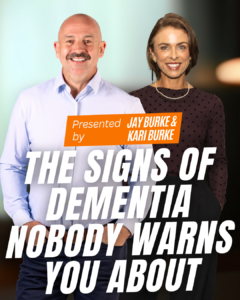
- From Fine Answers podcast – Kari Burke
Why aged care planning is often about more than money, and why earlier conversations may help families feel less alone.
Some family conversations are easy to put off.
Conversations about ageing parents. About health. About driving. About care. About what happens if someone can no longer make decisions in the same way they once could.
In Fine Answers Podcast #172, host Jay Burke from Burke Britton Financial Partners sits down with Kari Burke to talk about her family’s experience supporting her father, Mal, after his diagnosis with frontotemporal dementia. It is a personal conversation, but one that may feel familiar to many families who are raising children while also beginning to support ageing parents.
Key idea: Aged care decisions are rarely just financial. They are emotional, practical and deeply personal. Having earlier conversations may help families feel more prepared when difficult decisions arise.
The early signs may not look like forgetfulness
When many people think about dementia, they may first think about memory loss. For Kari’s family, some of the early signs looked different.
Looking back, Kari described changes that included increased anxiety, withdrawing from social activities, losing interest in golf and friends, and becoming less comfortable in situations that had once felt normal. At the time, those changes were not always easy to interpret.
“Hindsight is interesting. You look back now and recognise, with today’s lens, that things were changing.”
That is one of the difficult parts for families. Changes can happen gradually. They can be explained away. And when the person affected is proud, capable and used to managing their own life, it can be hard for everyone involved to accept that something more serious may be happening.
Families often see what appointments do not
One of the recurring themes in Jay and Kari’s conversation was advocacy. A doctor or specialist may only see a short appointment. Families often see the day-to-day changes.
They may see the repeated questions, confusion, social withdrawal, strain on a spouse, or moments that do not quite feel right. Kari also spoke about how someone experiencing cognitive change may still present well in a short consultation, which can make it harder for family members to feel heard.
The episode does not suggest families should diagnose or manage this alone. Rather, it highlights that families may need to keep advocating, documenting concerns and seeking appropriate medical guidance when they believe something has changed.
The hardest decisions are often about independence
For many families, one of the most confronting topics is driving. Driving can represent freedom, confidence and independence, so raising concerns can feel like taking something away from someone who has spent a lifetime managing for themselves.
In Kari’s family, driving became one of the difficult conversations as Mal’s condition progressed. Kari described the tension clearly: the decision was not only about Mal’s independence, but also about safety for him and others.
“Sometimes you have to remove yourself from the situation and take the emotion out of it, and just do what is best for everybody.”
For families listening, the broader message is not to rush to conclusions. It is to recognise that some decisions may need to be made with care, courage and support.
Aged care is not one decision, but a series of decisions
The move from home support, to respite, to permanent aged care did not happen in one simple step.
Kari and Jay spoke about the sale of a long-held family home, the move into a lifestyle village, trying to access support through My Aged Care, respite care and then the eventual decision that permanent care was appropriate. Each stage carried its own practical and emotional weight.
For families, this is an important point. Aged care rarely feels like a neat process. Circumstances can change quickly, and what seemed suitable a few months earlier may no longer meet the person’s needs.
Kari also spoke about the value of talking to others who had already been through the process. Practical guidance from another family helped her better understand what to ask and how to advocate.
Questions that may be worth discussing earlier
These conversations can be uncomfortable, but some families may find it useful to discuss them before decisions become urgent:
- What support would Mum or Dad prefer if their health changed?
- Who would help make decisions if they could not make them alone?
- Are powers of attorney and medical decision-making documents in place?
- What would staying at home realistically require?
- What would the family need to understand before considering residential aged care?
These are not one-size-fits-all questions. They are starting points for family discussion and, where appropriate, conversations with medical, legal and financial professionals.
The financial side can be hard to separate from the emotional side
Jay noted that even as a financial adviser, the aged care system still came with complexity. Accommodation payments, means testing, service packages and changing care needs can create confusion for families who are already under emotional pressure.
The conversation also touched on the importance of reviewing additional service packages over time, particularly where a resident’s capacity to benefit from certain services may change.
That does not mean every optional service is inappropriate. For some residents, additional services may provide genuine value. The point is that families may benefit from understanding what is being paid for, what is being used, and whether it still matches the person’s needs.
This is where financial advice can be useful. Not because an adviser can remove the emotion from the decision, but because they can help families understand the financial implications and avoid making decisions based only on stress or uncertainty.
So what does this mean for families?
Kari’s reflections were not about having perfect answers. They were about love, responsibility and trying to make good decisions in a difficult season of life.
She spoke about spending time with people while it is possible, having conversations before a crisis, being patient with family members, and letting go of guilt where possible.
“It can feel like mourning someone who is still alive.”
For many families, aged care planning is not a single event. It is an ongoing conversation about care, dignity, capacity, money, family roles and what support may be needed over time.
A plan is unlikely to remove the emotional difficulty of seeing someone you love decline, but thoughtful preparation may help families approach those moments with more clarity, compassion and support.